

RESTORING HOPE BLOG
children's lives transformed, cycles of poverty broken and opportunities before us
From Grief to Hope: A Day in the Life of Our Social Workers
What does it actually look like to care for orphaned and vulnerable children? Not for a week, not for a season—but for an entire childhood?
We recently sat down for a long conversation with two of our longest-serving staff members: a husband-and-wife team of indigenous social workers who have given a combined 24 years to this work in South Asia.
For security reasons, we can't share their names, but we wanted our wider community to know what their calling looks like in their own words!
A calling that started early
Both of them will tell you this work began long before it was a job.
She grew up gathering the children of her community for Sunday school. Every week, she went house to house, reminding families it was time to come. When the children weren't interested (Sunday was, after all, their only day off) her mother gave her a small offering to buy chocolates as an incentive. It worked. A young lady with a pocketful of chocolates and a heart for children grew up to spend her life doing exactly that: gathering children, one by one.
He grew up as a pastor's son, listening as families came to his father with heartbreaking prayer requests. Between tears, they'd share of no food, no support, nowhere to turn.
"From childhood," he told us, "I had a dream that I wanted to help the poor." Years before he officially joined Restoring Hope's staff, he was already tutoring some of our children in the evenings after his own classes.
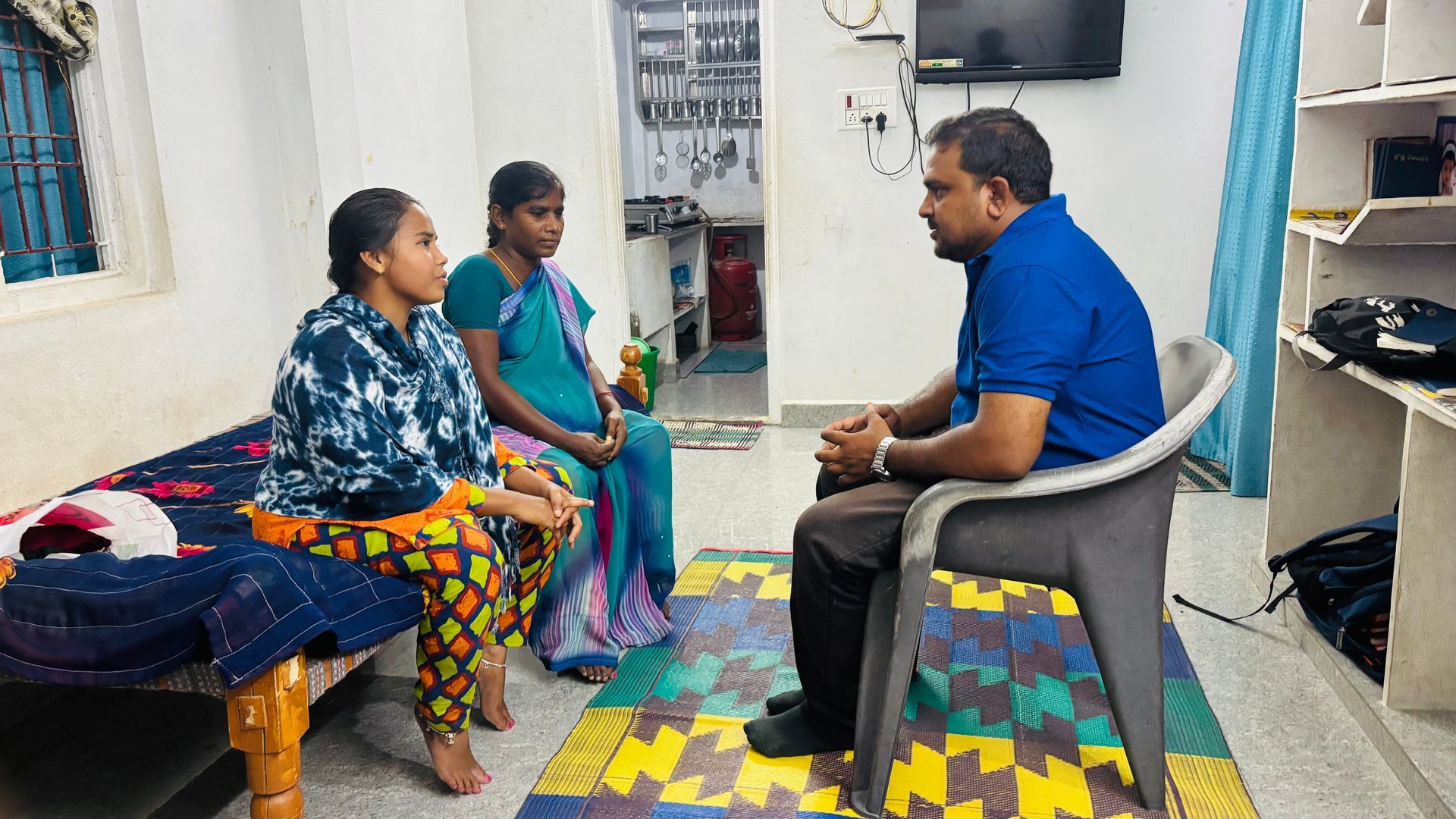
Pictured: A Restoring Hope social worker meets with a student and her widowed mother
social work means showing up
Ask them to describe an average day and you'll hear a long list: visiting children and families, checking on schoolwork and exam results, meeting with college staff, counseling caregivers, organizing prayer gatherings, writing child reports, answering calls late into the evening.
But underneath the list is one critical element: presence. Showing up, again and again, for families of loss who often have no one else showing up for them.
Much of their work centers on single mothers, women who are often uneducated, spiritually isolated, and treated harshly in their culture simply because there is no father in the home. Our social workers sit with these families. They listen, pray, and counsel. They connect them with local support.
And then they come back the next month and do it again.
One of them told us her greatest joy is watching girls complete their education and become independent. "When I see the girl children are independent," she said, "it makes me so happy. I feel very proud."
In communities where many families never imagined a daughter finishing school, she has helped make graduates—including two sisters who grew up with only their mother but are now the most educated people in their entire village!

Pictured: A Restoring Hope social worker meets with two students
The hardest part is also the best part
We asked what the hardest part of the job is. The answer came without hesitation: listening to the heartbreaking stories. Children with no relatives to lean on. Families with no support at all.
But then came the rest of the answer.
Visit by visit, prayer by prayer, counseling session by counseling session, transformation begins. "When I see the transformation of the families," he said, "that is the rewarding point." The hardest part of the job becomes the most rewarding part.
And that is the entire job description of a social worker: walking with a family from grief and loss into hope and faith for the future.
Why it matters
Our social workers are the hands and feet of everything Restoring Hope's partners make possible. Every contribution, every prayer, every re-share on social media flows through people like these two social workers. They do the frontline work of showing up to care for families of orphaned and vulnerable children, but they couldn't do it without you.
And that's why they asked us to pass along a message to all who support their work: "Thank you." More specifically: "Your love and affection made us [be able to] help others."
ENABLE A SOCIAL WORKER TO KEEP SHOWING UP
Every visit, every prayer, every counseling session happens because someone made it possible. A gift of $300 enables a social worker to show up for 50 families with orphaned and vulnerable children. It provides presence, month after month, for the children who need it most. Would you give a gift to help our social workers today?
*Pseudonyms are used to protect the identities of people and areas Restoring Hope serves.

Get our children’s e-book FREE
when you sign up to get stories like these delivered to your email!
GET THE E-BOOK
Don't worry; we won't spam you, and your information is kept private.